

My posts on

My former Anima Ex Machina blog
All Publications
Over 140 peer-reviewed contributions indexed in

H-index and list sorted by citation numbers available on

Peer-reviewed Papers
Letter numbering code:
J: journal | P: proceeding or chapter
# co-first author if not listed first
* corresponding author | ^ sorted alphabetically
| Selected List |

139. J88. A Review of Point-of-Care Devices for Blood-Testing Towards AI-driven Remote Digital Care, Precision Healthcare and Predictive Medicine
J. Gu, A. Uthamacumaran, H. Zenil
Computer Methods and Programs in Biomedicine Update, vol. 10, 100258, 2026. [online]
138. J87. Multi-omic Enriched Blood-Derived Digital Signatures Reveal Mechanistic and Confounding Disease Clusters for Differential Diagnosis
B. Liu, A. Uthamacumaran, A. Fulton, H. Zenil
Frontiers in Network Physiology, 2026. [online]

137. J86. Binarized neural networks converge toward algorithmic simplicity: empirical support for the learning-as-compression hypothesis
E. Y. Sakabe, F. S. Abrahão, A. Simões, E. Colombini, P. Costa, R. Gudwin, H. Zenil
Frontiers in Computational Neuroscience, vol. 20, 1791546, 2026 [online]
136. J85. A quantitative approach to estimating bias, favoritism and distortion in scientific journalism
R. Koushik, H. Zenil
Frontiers in Communication, vol 11, 1772794, 2026 [online]
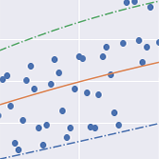
135. J84. Integrative adaptive indexes from noisy routine haematological markers can predict and discriminate health status and biological age
S. Hernandez-Orozco, A. Uthamacumaran, F. Hernandez-Quiroz, K. Saeb-Parsy, H. Zenil
Computers in Biology and Medicine, vol 208, 111628, 2026 [online]
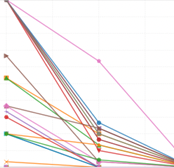
134. J83. SuperARC: a test for artificial superintelligence based on compressed modelling, recursive prediction and problem complexity
A. Hernández-Espinosa, L. Ozelim, F. S. Abrahão, H. Zenil
Nature Communications, 17: 4885, 2026 [online]
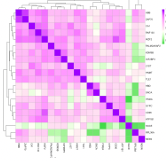
133. J82. Neurodivergent Influenceability as a Contingent Solution to the AI Alignment Problem
A. Hernández-Espinosa, F.S Abrahão, O. Witkowski, H. Zenil
PNAS Nexus, vol. 5:4, pgag076, 2026 [online]
132. J81. Assembly Theory Collapses to Dictionary Compression and Is Rendered Redundant by Common Statistical Algorithms
L. Ozelim, A. Uthamacumaran, F.S Abrahão, S. Hernández-Orozco, N.A Kiani, J. Tegnér, H. Zenil
npj Complexity, 2026 (accepted) [arxiv]
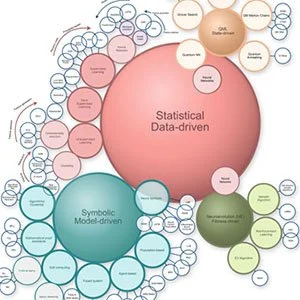
131. J80. The future of fundamental science led by generative closed-loop artificial intelligence
H Zenil, J Tegnér, FS Abrahão, A Lavin, V Kumar, JG Frey, A Weller, ...
Frontiers in Artificial Intelligence 11;9:1678539, 2026 [online]

130. J79. Leveraging network motifs to improve artificial neural networks
H. Zhang, C.-H. Yang, H. Zenil, P.-Y. Chen, Y. Shen, N. A. Kiani, and J. Tegner
Nature Communications, 16: 11495 2025 [online]

129. P53. On Circular Growth of Life-Like Automata
G.J. Martínez, A. Adamatzky, H. Zenil, J.C. Seck-Tuoh-Mora
In: A. Adamatzky, G.C. Sirakoulis, G.J. Martinez (eds) Advances in Cellular Automata. Emergence, Complexity and Computation, vol 53. Springer Nature, 2025. [Online]
128. J78. Advancing the Scientific Method with Large Language Models: From Hypothesis to Discovery
Y. Zhang, i.a. M. Levin, J. Frey, J. Evans, A. Bundy and H. Zenil
npj Artificial Intelligence 1, 14, 2025. [online]

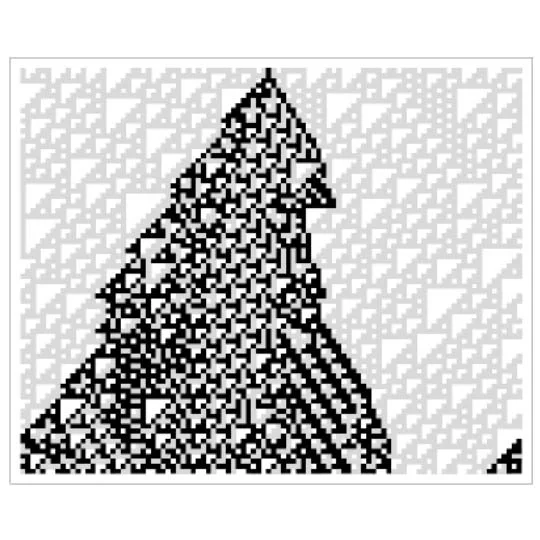
126.P52. The Emergent Behavior of Computer Programs of Short Description Length in Discrete Time and Discrete Space
H. Zenil
Foundational Papers in Complexity Science pp. 1735–1792, Santa Fe Institute, 2024 [online, partial preprint].
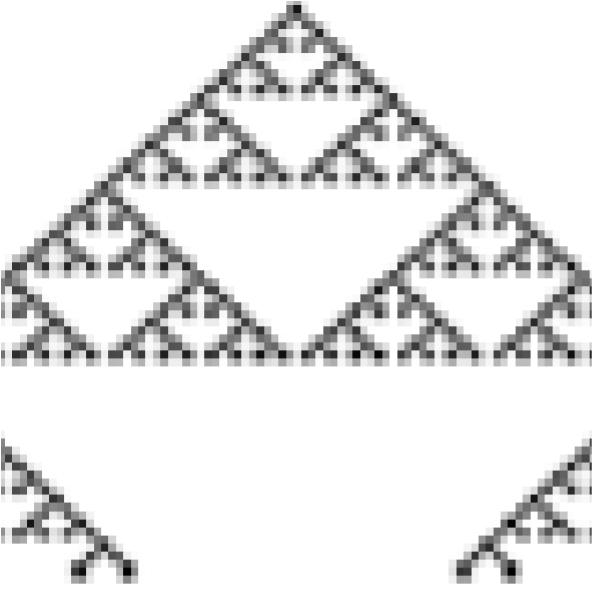
125. P51. The Emergent Behavior of Computer Programs of Short Description Length in Discrete Time and Discrete Space
Hector Zenil
Introduction to Universality and Complexity in Cellular Automata by Stephen Wolfram, In Foundational Papers in Complexity Science: Volume I by David C. Krakauer, 2024 [online].


123. J74. Scientific Hypothesis Generation by a Large Language Model: Laboratory Validation in Breast Cancer Treatment
A. Abdel-Rehim, H. Zenil, i.a., Ross D. King
Royal Society Interface 22: 20240674. 2025 [online].


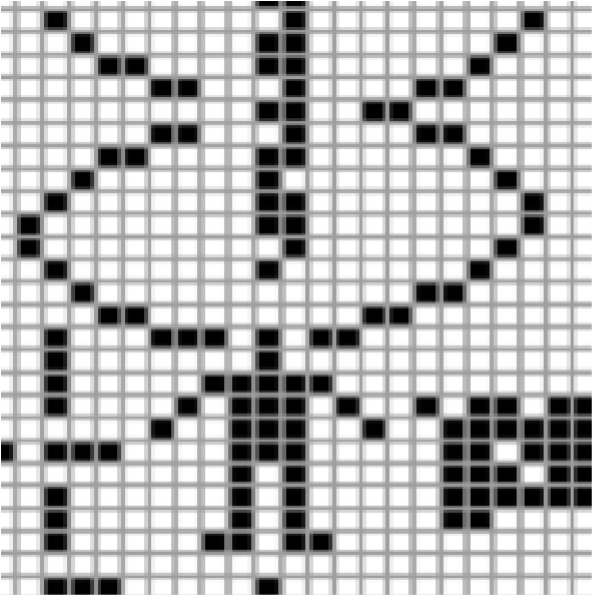
119. Optimal Spatial Deconvolution and Message Reconstruction from a Large Generative Model of Models H. Zenil, A. Adams, F.S. Abrahão (submitted) [preprint].

118. J70. On the Salient Limitations of the Methods of Assembly Theory and their Classification of Molecular Biosignatures
A. Uthamacumaran, F.S. Abrahão, N.A. Kiani, H. Zenil
npj Systems Biology and Applications 10, 82, 2024. [online].

117. J69. A Review of Mathematical and Computational Methods in Cancer Dynamics
A. Uthamacumaran and H. Zenil
Frontiers in Oncology, vol. 12, 2022 [online]

116. P50. Artificial intelligence in scientific discovery: Challenges and opportunities
H. Zenil and R. King
in Artificial Intelligence in Science: Challenges, Opportunities and the Future of Research, OECD Publishing, Paris, 2023 [online].

114. P47. The Far Future of AI in Scientific Discovery
H. Zenil and R. King
In Choudhary, Fox and Tony Hey, AI For Science, World Scientific Publishing Company/Imperial College Press, 2023.

113. J68. Simulation Intelligence: Towards a New Generation of Scientific Methods
A. Lavin, H. Zenil, B. Paige, D. Krakauer, J. Gottschlich, T. Mattson, A. Anandkumar, S. Choudry, K. Rocki, A. Güneş Baydin, C. Prunkl, O. Isayev, E. Peterson, P. L. McMahon, J. Macke, K. Cranmer, J. Zhang, H. Wainwright, A. Hanuka, M. Veloso, S. Assefa, S. Zheng, A. Pfeffer (forthcoming) [preprint]

112. J67. Emergence and Algorithmic Information Dynamics of Systems and Observers
F. S. Abrahão and H. Zenil
Philosophical Transactions of the Royal Society A, 2022 [online]

111. J66. Algorithmic Probability of Large Datasets and the Simplicity Bubble Problem in Machine Learning
F.S. Abrahão, H. Zenil*, F. Porto, and K. Wehmuth
(forthcoming) [preprint]

110. P46. Algorithmic Information Dynamics of Cellular Automata
H. Zenil and A. Adams
In S. Das et al (eds) The Mathematical Artist: A Tribute to John Horton Conway
World Scientific Publishing Press, 2022 [preprint]

107. P44. Artificial Intelligence in Medicine and Causality for Precision and Value-based Healthcare
H. Zenil
In N. Lidströmer and H. Ashrafian (eds.)
Artificial Intelligence in Medicine, Springer Verlag, 2021 [online]

106. P43. Causal Diagnostics for Cancer and Complex Diseases
H. Zenil
In I. Balaz and A. Adamatzky, Cancer, Complexity, Computation, World Scientific Publishing Company, Springer, 2021 [Amazon]

105. P42. Les ordinateurs peuvent-ils produire du hasard? Une exploration de la découverte causale (Can computers produce randomness? An exploration of causal discovery)
H. Zenil
In Pour quoi moi? chap. 4, Belin Sciences et Nature, 2021 [online]


103. P41. Algorithmic Information Dynamics
H. Zenil, N.A. Kiani, F.S. Abrahao and J. Tegnér
Scholarpedia, 15(7):53143, 2020.[online]

102. J63. Non-Classical Logics in Unconventional Computing
A. Schumann and H. Zenil
International Journal of Unconventional Computing, pp. 237-244, vol. 15, No.4, 2020 [online]

101. J62. A Review of Methods for Estimating Algorithmic Complexity: Options, Challenges, and New Directions
H. Zenil
Entropy, 22, 612, 2020. (special issue on Shannon Entropy and Kolmogorov complexity) [online]

100. P40. Evolving Neural Networks through a Reverse Encoding Tree
H. Zhang, C-H. Huck Yang, H. Zenil, N.A. Kiani, Y. Shen and J. Tegnér
IEEE World Congress on Computational Intelligence 2020. [preprint]

99. P39. Algorithmic Information Distortions in Node-Aligned and Node-Unaligned Multidimensional Networks
F.S. Abrahao, K. Wehmuth, H. Zenil, and A. Ziviani
Entropy 2021, 23(7), 835 [online]

98. J60. Towards Demystifying Shannon Entropy, Lossless Compression, and Approaches to Statistical Machine Learning
H. Zenil
Proceedings 47, no. 1: 24, 2020 [online]


96. J58. A Novel Method for Reconstructing CT Images in GATE/GEANT4 with Application in Medical Imaging: A Complexity Analysis Approach
N. Gholamia, M. Mahdi Dehshibia, M. Fazlalib, A. Rueda-Toicen, H. Zenil, A. Adamatzky
Journal of Information Processing, vol. 28 pp. 161–168, 2020. [online, preprint]

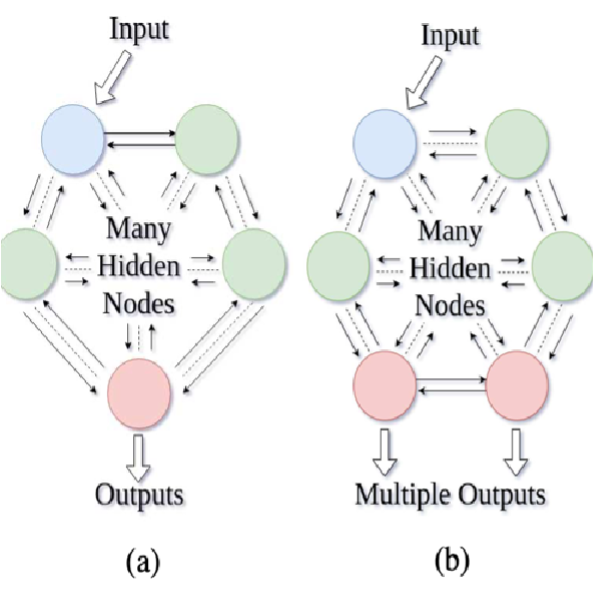
94. J57. Controllability, Multiplexing, and Transfer Learning in Networks using Evolutionary Learning
R. Ooi, C.-H. Huck Yang, P.-Yu Chen, V. Eguiluz, N.A. Kiani, H. Zenil, D. Gómez-Cabrero, J. Tegnér
(submitted) [preprint]

93. P37. Estimations of Integrated Information Based on Algorithmic Complexity and Dynamic Querying
A. Hernández-Espinosa, H. Zenil^*, N.A. Kiani, and J. Tegnér
In Handbook of Unconventional Computing, A. Adamatzky (Ed.), World Scientific Publishing Company, 2022 [preprint]

92. J56. A Review of Graph and Network Complexity from an Algorithmic Information Perspective
H. Zenil, N.A. Kiani, J. Tegnér
Entropy, 20(8):551, 2018. [online]


90. J54. Community assessment to advance computational prediction of cancer drug combinations in a pharmacogenomic screen
S.M Hill, L.M. Heiser, (…) i.a. H. Zenil (DREAM Challenge Consortium) (…), G. Stolovitzky, J. Guinney, J.R Dry, J. Saez-Rodriguez
Nature Communications, vol. 10, Article number: 2674, 2019. [online] (NPG)

89. P36. On the Complex Behaviour of Natural and Artificial Machines and Systems
H. Zenil
In F.P. Bonsignorio, A.P. del Pobil, E. Messina, J. Hallam (eds.), Metrics of sensory motor integration in robots and animals
Springer Cosmos Series, Cognitive Systems Monographs, Springer, pp.111-125,2019 [Amazon, preprint]

88. J53. Minimal Algorithmic Information Loss Methods for Dimension Reduction, Feature Selection and Network Sparsification
H. Zenil*, N.A. Kiani, A. Rueda-Toicen, A. Zea, J. Tegnér
Information Sciences 720 (2025) 122520 [online]

87. J52. The Thermodynamics of Network Coding, and Algorithmic Refinement of the principle of Maximum Entropy
H. Zenil*, N.A. Kiani, J. Tegnér
Entropy, 21(6), 560, 2019 [online] (MDPI)
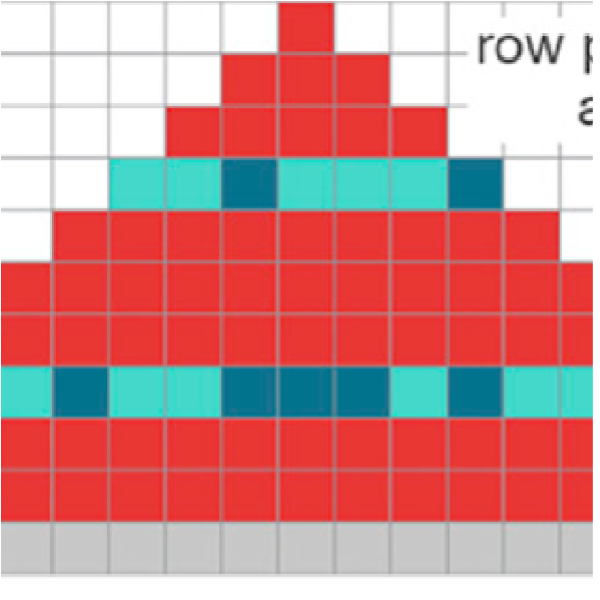

85. J50. Algorithmically Probable Mutations Reproduce Aspects of Evolution, such as Convergence Rate, Genetic Memory, and Modularity
S. Hernández-Orozco, N.A. Kiani, H. Zenil*
Royal Society Open Science, 5:180399, 2018 [online] (Royal Society)

84. J49. A Decomposition Method for Global Evaluation of Shannon Entropy and Local Estimations of Algorithmic Complexity
H. Zenil, S. Hernández-Orozco, N.A. Kiani, F. Soler-Toscano, A. Rueda-Toicen
Entropy 20(8), 605, 2018. [online] (MDPI)

83. P35. Algorithmic Information Dynamics of Emergent, Persistent, and Colliding Particles in the Game of Life
H. Zenil, N.A. Kiani and J. Tegnér
In A. Adamatzky (ed), From Parallel to Emergent Computing (book)
Taylor & Francis / CRC Press, pp.367–383, 2019 [preprint]

82. P34. Model Discovery and Discrete Inverse Problems with Cellular Automata and Boolean Networks
H. Zenil*, Y. Zhang and N.A. Kiani
In A. Adamatzky, Automata and Complexity, Eric Goles festschrift, Springer, 2022. [Amazon]
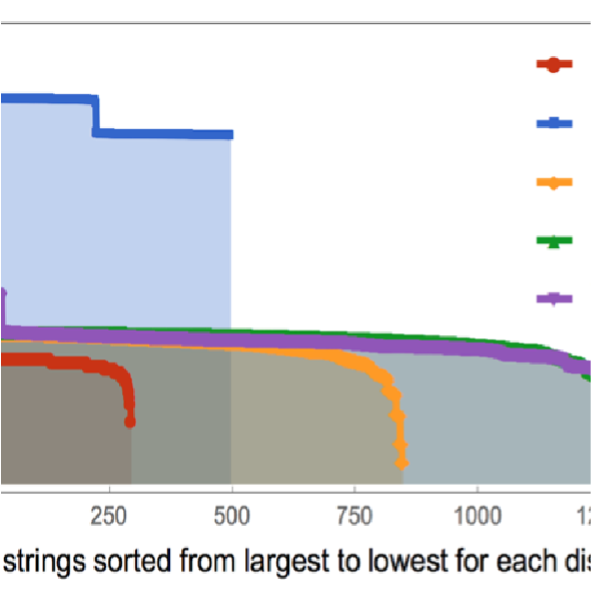
80. J47. Coding-theorem Like Behaviour and Emergence of the Universal Distribution from Resource-bounded Algorithmic Probability
H. Zenil*, L. Badillo, S. Hernández-Orozco and F. Hernandez-Quiroz
International Journal of Parallel Emergent and Distributed Systems, 2018 [online, preprint] (Taylor & Francis)

79. J46. Rule Primality, Minimal Generating Sets and Turing-Universality in the Causal Decomposition of Elementary Cellular Automata
J. Riedel and H. Zenil^*
Journal of Cellular Automata, vol. 13, pp. 479–497, 2018 [online, preprint]

78. J45. Algorithmic Complexity and Reprogrammability of Chemical Structure Networks
H. Zenil*, N.A. Kiani, M-M. Shang, J. Tegnér
Parallel Processing Letters, vol. 28, 2018. [online, preprint] (World Scientific)

77. J44. Cross-boundary Behavioural Reprogrammability Reveals Evidence of Pervasive Universality
J. Riedel, H. Zenil^*
International Journal of Unconventional Computing, vol 13:14-15 pp. 309-357, 2018 [online, preprint]

76. J43. Slime Mould: The Fundamental Mechanisms of Biological Cognition
J. Vallverdú, O. Castro, R. Mayne, M. Talanov, M. Levine, F. Baluska, Y. Gunji, A. Dussutourg, H. Zenil, A. Adamatzky
BioSystems, vol. 165, pp 57-70, 2018 [online, preprint] (Elsevier)

75. J42. Approximations of Algorithmic and Structural Complexity Validate Cognitive-behavioural Experimental Results
H. Zenil*, J.A.R. Marshall, J. Tegnér
Frontiers In Computational Neuroscience, vol. 16, 2023 [online]

73. J40. Undecidability and Irreducibility Conditions for Open-Ended Evolution and Emergence
S. Hernández-Orozco, F. Hernández-Quiroz and H. Zenil*
Artificial Life, vol. 24:1, pp. 56–70, 2018 [online, preprint] (MIT)


71. J38. Reprogramming Matter, Life and Purpose. H. Zenil
International Journal of Unconventional Computing, vol. 13.3, p. 221–233, 2017. [online, preprint] (OCP)

70. J37. HiDi: An efficient reverse engineering schema for large scale dynamic regulatory network reconstruction using adaptive differentiation
Y. Deng, H. Zenil*, J. Tegnér, N.A. Kiani
Bioinformatics btx501, 2017. [preprint, online] (Oxford)

69. J36. East-West Paths to Unconventional Computing: Complexity in Causality
S. Akl, M. Burgin, C.S. Calude, M.M. Dehshibi, Y. Gunji, Z. Konkoli, B. Maclenna, B. Marchal, M. Margenstern, G.J. Martinez, R. Mayne, K. Morita, A. Schumann, G.Ch. Sirakoulis, K. Svozil, H. Zenil, A. Adamatzky
Progress in Biophysics & Molecular Biology, 131:469–493, 2017. doi: 10.1016/j.pbiomolbio.2017.08.004. [online, preprint] (Elsevier)

68. J35. Low Algorithmic Complexity Entropy-deceiving Graphs
H. Zenil*, N.A. Kiani and J. Tegnér
Physical Review E 96, 012308, 2017.
[online] (APS)

67. J34. Formal Definitions of Unbounded Evolution and Innovation Reveal Universal Mechanisms for Open-Ended Evolution in Dynamical Systems
A. Adams, H. Zenil, P.W.C. Davies, S.I. Walker
Scientific Reports 7, No:997, 2017. [online] (NPG)
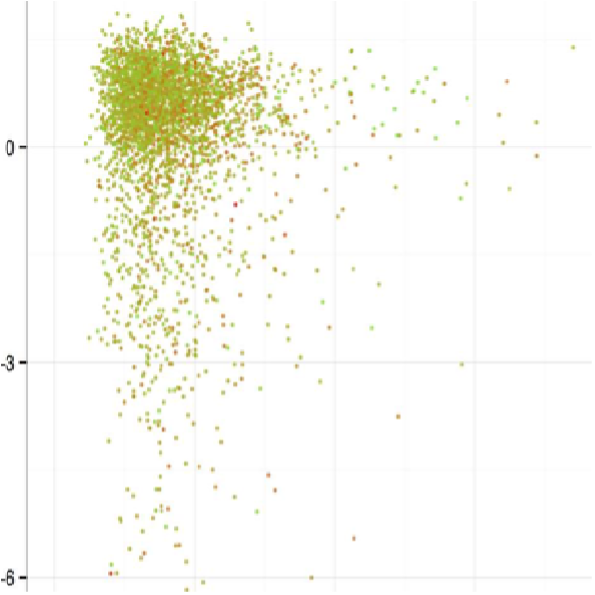
66. J33. Human Behavioral Complexity Peaks at Age 25
N. Gauvrit, H. Zenil*, F. Soler-Toscano, J.-P. Delahaye, P. Brugger
PLoS Comput Biol 13(4): e1005408, 2017. [online, video, supplementary information (SI)] (PLOS)


64. P32. Approximations to Algorithmic Probability
H. Zenil
In Robert A. Meyers (ed), 2nd. Edition of the Springer Encyclopedia of Complexity and Systems Science, 2017.
63. P31. Cognition and the Algorithmic Nature of the Mind
H. Zenil
In Robert A. Meyers (ed), 2nd. Edition of the Springer Encyclopedia of Complexity and Systems Science, 2017.


61. P29. Is there any Real Substance to the Claims for a ‘New Computationalism’?
A. Hernández-Espinosa, F. Hernández-Quiroz and H. Zenil
In J. Kari, F. Manea, I. Petre (eds) Unveiling Dynamics and Complexity (Computability in Europe 2017), Springer Verlag, 2017. [preprint]

60. P28. Causality, Information and Biological Computation: An algorithmic software approach to life, disease and the immune system
H. Zenil, A. Schmidt, J. Tegnér
In S I. Walker, P.C.W. Davies and G. Ellis (eds.), Information and Causality: From Matter to Life.
Cambridge University Press, pp. 244-279, 2017. [preprint, Amazon]

59. P27. Algorithmic Data Analytics, Small Data Matters and Correlation versus Causation
H. Zenil
In M. Ott, W. Pietsch, J. Wernecke (eds.), Berechenbarkeit der Welt? Philosophie und Wissenschaft im Zeitalter von Big Data (Computability of the World? Philosophy and Science in the Age of Big Data)
Springer Verlag, pp 453-475, 2017. [online, preprint]

58. J32. Perspective on Bridging Scales and Design of Models using Low-Dimensional Manifolds & Data-driven Model Inference
J. Tegner, H. Zenil, N.A. Kiani, G. Ball, D. Gomez-Cabrero
Philosophical Transactions of the Royal Society A, volume 374, issue 2080, 2016. [online] (Royal Society)

57. J31. Inferring causal molecular networks: Empirical Assessment of Causal Network Learning through a Community-based Effort
S.M Hill, L.M. Heiser, (…) i.a. H. Zenil (DREAM Challenge Consortium) (…), S. Mukherjee, G. Stolovitzky, J. Saez-Rodriguez
Nature Methods 13, pp. 310–318, 2016. [online] (NPG)
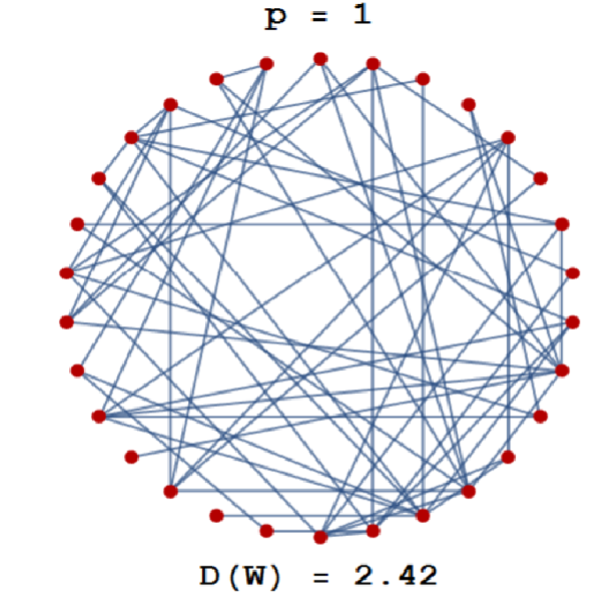
56. J30. Methods of Information Theory and Algorithmic Complexity for Network Biology
H. Zenil, N.A. Kiani and J. Tegnér
Seminars in Cell and Developmental Biology, vol. 51, pp. 32-43, 2016. [online, preprint] (Elsevier)

55. J29. Fractal Dimension versus Process Complexity
J.J. Joosten, F. Soler-Toscano, and H. Zenil*
Advances in Mathematical Physics vol. 2016, Article ID 5030593 [online] (Hindawi)

54. J28. Flow of Information in Biological Systems
A. Masoudi-Nejad and H. Zenil*
Seminars in Cell and Developmental Biology, vol. 51 pp 1-2, 2016. [online] (Elsevier)


52. J26. Evaluating Network Inference Methods in Terms of Their Ability to Preserve the Topology and Complexity of Genetic Networks
N.A. Kiani, H. Zenil*#, J. Olczak and J. Tegnér
Seminars in Cell and Developmental Biology, vol. 51, pp. 44-52, 2016. [online, preprint] (Elsevier)

51. P26. The Limits of Decidable States on Open-Ended Evolution and Emergence
S. Hernández-Orozco, F. Hernández-Quiroz and H. Zenil*
Artificial Life, vol. 24(1) pp. 56-70, 2018. [online] (MIT)

50. P25. Formal definitions of Unbounded Evolution and Innovation Reveal universal Mechanisms for Open-ended evolution in Dynamical Systems
A. Adams, H. Zenil, P.C.W. Davies and S.I. Walker
Second Workshop on Open-Ended Evolution, 15th International Conference on the Synthesis and Simulation of Living Systems (ALIFE), 2016. [online, preprint]

49. P24. Asymptotic Intrinsic Universality and Reprogrammability by Behavioural Emulation
H. Zenil and J. Riedel
Advances in Unconventional Computation. A. Adamatzky (ed)
Springer Verlag, pp. 205-220, 2016. [preprint]

48. J25. Algorithmic complexity for psychology: A user-friendly implementation of the coding theorem method
N. Gauvrit, H. Singmann, F. Soler-Toscano, H. Zenil*
Behavior Research Methods, Volume 48, Issue 1, pp. 1-16, 2015. doi:10.3758/s13428-015-0574-3 [preprint, online] (Springer)

47. P23. Topological Evaluation of Methods for Reconstruction of Genetic Regulatory Networks
J. Olczak, N.A. Kiani, H. Zenil* and J. Tegnér
Proceedings of the IEEE Workshop on Complex Networks, SITIS, Bangkok 2015. [online]
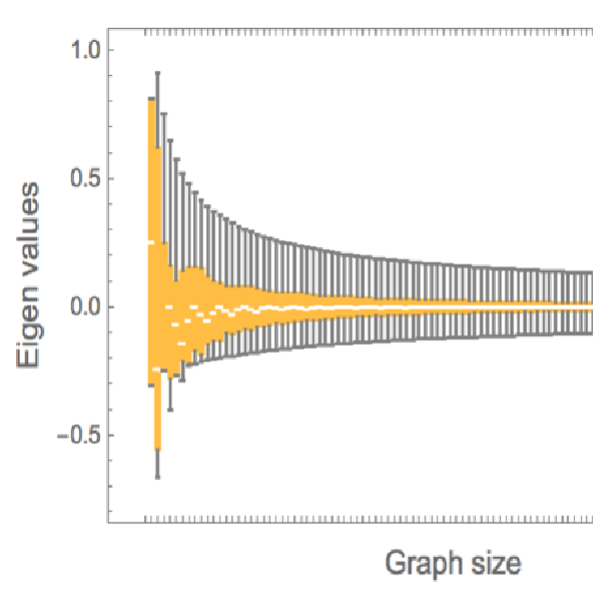
46. P22. Numerical Investigation of Graph Spectra and Information Interpretability of Eigenvalues
H. Zenil, N.A. Kiani, J. Tegnér
In F. Ortuño & I. Rojas (Eds.): 3rd International Work-Conference on Bioinformatics and Biomedical Engineering (IWBBIO) 2015, Part II,
LNCS 9044, pp. 395–405. Springer, 2015. [preprint, online]

45. P21. The Effects of Global Rules on Interacting Cellular Automata
A. Adams, H. Zenil, E. Reyes, J. Joosten
In J. Kari, I. Törmä, M. Szabados (Eds.), 21st International Workshop on Cellular Automata and Discrete Complex Systems
AUTOMATA 2015, TUCS Lecture Notes, 2015.

44. J24. Algorithmicity and Programmability in Natural Computing with the Game of Life as an In Silico Case Study
H. Zenil
Journal of Experimental & Theoretical Artificial Intelligence, Volume 27, Issue 1, pp. 109-121, 2015. [online] (Taylor & Francis)

43. J23. Complexity Measurement Based on Information Theory and Kolmogorov Complexity
L. Ting Lui, G. Terrazas, H. Zenil, C. Alexander and N. Krasnogor
Artificial Life, vol. 21:2, pp. 205-24 2015. [online] (MIT Press)

42. J22. Two-Dimensional Kolmogorov Complexity and Validation of the Coding Theorem Method by Compressibility
H. Zenil, F. Soler-Toscano, J.-P. Delahaye and N. Gauvrit
PeerJ Computer Science, 1:e23, 2015. [online] (PeerJ)

41. J21. Natural Scene Statistics Mediate the Perception of Image Complexity
N. Gauvrit, F. Soler-Toscano, H. Zenil*
Visual Cognition, Volume 22, Issue 8, pp. 1084-1091, 2014. [preprint, online] (Taylor & Francis)


39. J19. Correlation of Automorphism Group Size and Topological Properties with Program-size Complexity Evaluations of Graphs and Complex Networks
H. Zenil, F. Soler-Toscano, K. Dingle and A. Louis
Physica A: Statistical Mechanics and its Applications, vol. 404, pp. 341–358, 2014. [online, preprint, video]
(Elsevier)

38. P20. Programmability: A Turing Test Approach to Computation
H. Zenil
In L. De Mol and G. Primiero (eds.), Turing in Context, Koninklijke Vlaamse Academie van België voor Wetenschappen en Kunsten
(Belgian Academy of Sciences and Arts), Contactforum, 2014.

37. J18. Algorithmic complexity for short binary strings applied to psychology: a primer
N. Gauvrit, H. Zenil*, F. Soler-Toscano and J.-P. Delahaye
Behavior Research Methods, vol. 46-3, pp 732-744, 2014. [preprint, online] doi: 10.3758/s13428-013-0416-0 (Springer)


35. J16. Correspondence and Independence of Numerical Evaluations of Algorithmic Information Measures
F. Soler-Toscano, H. Zenil#*, J.-P. Delahaye and N. Gauvrit
Computability, vol. 2, no. 2, pp 125-140, 2013. [online, preprint] (IOS)

34. J15. Exploring Programmable Self-Assembly in Non DNA-based Computing
G. Terrazas, H. Zenil and N. Krasnogor
Natural Computing, vol 12(4): 499–515, 2013. doi:10.1007/s11047-013-9397-2 [online, preprint] (Springer)

33. J14. Asymptotic Behaviour and Ratios of Complexity in Cellular Automata Rule Spaces
H. Zenil
International Journal of Bifurcation and Chaos vol. 23, no. 9, 2013. [online, preprint] (WSPC)


31. P18. Algorithmic Complexity of Animal Behaviour: From Communication to Cognition
H. Zenil
International Conference on the Theory and Practice of Natural Computing (TPNC) 2013. Cáceres, Spain, Cáceres, Spain

30. P17. Fractal Dimension of Space-time Diagrams and the Runtime Complexity of Small Turing Machines
J.J. Joosten, F. Soler-Toscano, H. Zenil
In T. Neary and M. Cook (Eds.), Machines, Computations and Universality (MCU 2013),
EPTCS 128, 2013, pp. 29-30, [abstract, presentation]

29. P16. Testing Biological Models for Non-linear Sensitivity with a Programmability Test
H. Zenil, G. Ball and J. Tegnér
In P. Liò, O. Miglino, G. Nicosia, S. Nolfi and M. Pavone (eds), Advances in Artificial Intelligence, ECAL 2013, pp. 1222-1223,
MIT Press, 2013. DOI: http://dx.doi.org/10.7551/978-0-262-31719-2-ch188 [online]


27. P15. Sparsity of Non-trivial Proving Speed-up in Random Systems of Propositional Calculus
S. Hernández-Orozco, F. Hernández-Quiroz and H. Zenil*
In Paola Bonizzoni, Vasco Brattka, Benedikt Löwe (eds.), The Nature of Computation, Logic, Algorithms, Applications,
Proceedings 9th. conference Computability in Europe, CiE 2013.

26. P14. A Turing Test-Inspired Approach to Natural Computation
H. Zenil
In G. Primiero and L. De Mol (eds.), Turing in Context II, Historical and Contemporary Research in Logic, Computing Machinery and Artificial Intelligence. Proceedings by the Royal Flemish Academy of Belgium for Science and the Arts, Belgium, 2013.

25. J12. Computation and Universality: Class IV versus Class III Cellular Automata
G.J. Martinez, J.C. Seck-Touh-Mora and H. Zenil
Journal of Cellular Automata, vol. 7, no. 5-6, pp. 393-430, 2013. (OCP)

24. P13. A Behavioural Foundation for Natural Computing and a Programmability Test
H. Zenil
In G. Dodig-Crnkovic and R. Giovagnoli (eds), Computing Nature: Turing Centenary Perspective, Springer SAPERE Series vol. 7, pp. 87-113, 2013. [online, preprint]
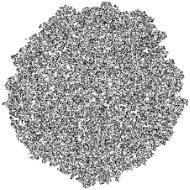
23. P12. Wolfram’s Classification and Computation in Cellular Automata Classes III and IV
G.J. Martinez, J.C. Seck-Touh-Mora and H. Zenil
In H. Zenil (ed), Irreducibility and Computational Equivalence: Wolfram Science 10 Years After the Publication of A New Kind of Science, Springer, 2013 [online, preprint]


21. P11. El Universo Algorítmico
H. Zenil
In, O. Miramontes and K. Volke (eds.) Fronteras de la Física en el Siglo XXI, CopIt arXives, UNAM, 2013 [PDF]


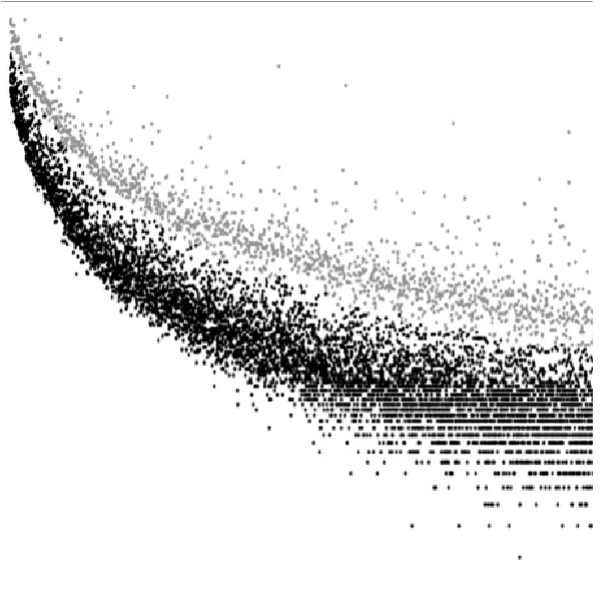
18. J8. Sloane’s Gap: Do Mathematical and Social Factors Explain the Distribution of Numbers in the OEIS?
N. Gauvrit, J.-P. Delahaye and H. Zenil
Journal of Humanistic Mathematics, vol. 3, no. 1, pp. 3-19, 2013. [preprint, featured in Numberphile] (Claremont College)

17. J7. On the Dynamic Qualitative Behaviour of Universal Computation
H. Zenil
Complex Systems, 20-3, pp 265-277, 2012. [online, preprint]

16. J6. Numerical Evaluation of Algorithmic Complexity of Short Strings: A Glance Into the Innermost Structure of Algorithmic Randomness
J.-P. Delahaye and H. Zenil#*^
Applied Mathematics and Computation 219, pp. 63-77, 2012. [online, preprint] (2011) (Elsevier)

15. J5. Empirical Encounters with Computational Irreducibility and Unpredictability
H. Zenil, F. Soler-Toscano and J.J. Joosten
Minds and Machines, vol. 22, Number 3, pp. 149-165, 2012. [preprint] (Springer)

14. J4. Image Characterization and Classification by Physical Complexity
H. Zenil*, J.-P. Delahaye and C. Gaucherel
Complexity, vol. 17-3, pages 26-42, 2012. [online, preprint] (Wiley)

13. P10. From Computer Runtimes to the Length of Proofs: With an Algorithmic Probabilistic Application to Waiting Times in Automatic Theorem Proving
H. Zenil
In M.J. Dinneen, B. Khousainov, and A. Nies (Eds.), Computation, Physics and Beyond International Workshop on Theoretical Computer Science, WTCS 2012, LNCS 7160, pp. 223-240, Springer, 2012. [online, preprint]

12. J3. Program-size versus Time complexity, Slowdown and speed-up phenomena in the micro-cosmos of small Turing machines
J.J. Joosten, F. Soler Toscano and H. Zenil#*
International Journal of Unconventional Computing, vol. 7, no. 5, pp. 353-387, 2011. [preprint] (OCP)


10. P9. Fractal Dimension as an Indication of the Terminating Runtime of Discrete Dynamical Systems
J.J. Joosten, H. Zenil and F. Soler-Toscano
In S. Thurner M. Szell (eds), Löcker Verlag, European Conference on Complex Systems (ECCS’11), 2011.

9. P8. Un método estable para la evaluación de la complejidad algorítmica de cadenas cortas (A Stable Method for the Evaluation of the Algorithmic Complexity of Short Strings).
H. Zenil, and J.-P. Delahaye
In G.J. Martinez, H. Zenil and C.R. Stevens (eds), Complex Systems as Computing Models, Luniver Press, 2011. [preprint]

7. P6. An Algorithmic Information-theoretic Approach to the Behaviour of Financial Markets.
H. Zenil and J.-P. Delahaye
In S. Zambelli, D.A.R. George (eds.) Nonlinearity, Complexity and Randomness in Economics: Towards Algorithmic Foundations for Economics, Wiley-Blackwell, 2011. [preprint]

6. P5. Complejidad descriptiva y computacional en máquinas de Turing pequeñas
J.J. Joosten, F. Soler-Toscano and H. Zenil
Actas de las V Jornadas Ibéricas, Lógica Universal e Unidade da Ciência, CFCU 2010. [preprint]

5. P4. Program-size versus Time complexity, Slowdown and speed-up phenomena in the micro-cosmos of small Turing machines
J.J. Joosten, F. Soler-Toscano and H. Zenil
In H. Guerra (ed.). Physics and Computation 2010, CAMIT, 3rd International Workshop on Physics and Computation 2010. [PDF]
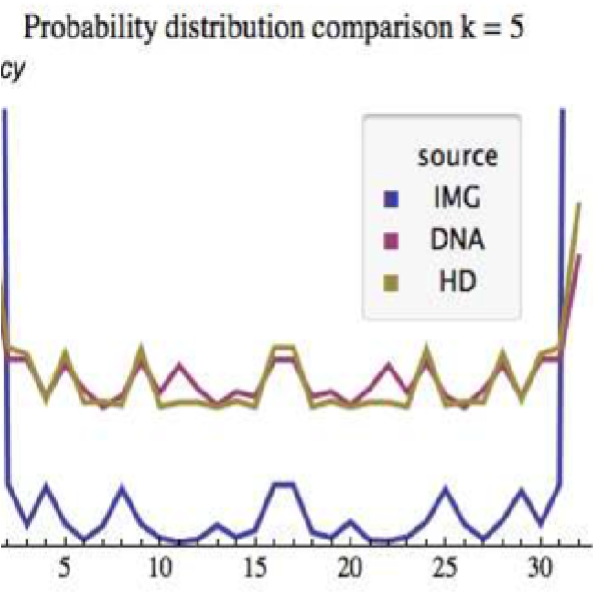
4. P3. On the Algorithmic Nature of the World
H. Zenil and J-P. Delahaye
In G. Dodig-Crnkovic and M. Burgin (eds), Information and Computation, World Scientific Publishing Company, 2010. [preprint]
3. J1. Compression-based Investigation of the Dynamical Properties of Cellular Automata and Other Systems
H. Zenil
Complex Systems, vol. 19, No. 1, pp. 1-28, 2010. [online]

2. P2. On the Kolmogorov-Chaitin complexity for short sequences
J-P. Delahaye and H. Zenil#
In C. Calude (ed) Randomness and Complexity: From Leibniz to Chaitin, World Scientific Publishing Company, 2007. [preprint]

1. P1. On the Possible Computational Power of the Human Mind
H. Zenil and F. Hernandez-Quiroz
In Worldviews, Science and Us, Philosophy and Complexity, C. Gershenson, D. Aerts, and B. Edmonds (eds),
World Scientific Publishing Company, 2007. [preprint]

-
1.- Portable device for imaging biological samples
H. Zenil
U.S. Patent 11175230, November 2021
______
2.- Wafer for carrying biological sample
H. Zenil
U.S. Patent 11534751, United States, December 2022
-
1. I. Zelinka, A. Sanayei, H. Zenil and O.E. Rössler (eds), How Nature Works, Complexity in Interdisciplinary Research and Applications, Series: Emergence, Complexity and Computation, Vol. 5, Springer, 2013.
2. H. Zenil (ed), Irreducibility and Computational Equivalence: Ten Years After the Publication of Wolfram’s A New Kind of Science, Series: Emergence, Complexity and Computation, Vol. 2, Springer, 2013. [book website]
3. H. Zenil (ed.), A Computable Universe: Understanding Computation & Exploring Nature As Computation, with a Foreword by Sir R. Penrose, World Scientific/Imperial College Press, 2012. [book website, Amazon]
4. G.J. Martínez, H. Zenil and C.R. Stephens (eds.), Sistemas Complejos Como Modelos de Computación (Complex Systems as Computing Models), Luniver, 2011. [Amazon]
5. H. Zenil, Lo que cabe en el espacio: develando las propiedades geométricas de nuestra realidad, (in Spanish), Copit ArXives UNAM , 2011. [paper and Kindle versions be free available at Amazon.com]
6. H. Zenil (ed.), Randomness Through Computation: Some Answers, More Questions, World Scientific/Imperial College Press, 2011. [book website]
7. H. Zenil (ed.), Cellular Automata and Discrete Complex Systems
Proceedings of the 26th IFIP WG 1.5 International Workshop, AUTOMATA 2020, Stockholm, Sweden.
Springer Nature, LNCS 12286, 2020 [online]
8. H. Zenil, F. Soler-Toscano and N. Gauvrit, Methods and Applications of Algorithmic Complexity: Beyond Lossless Compression, Springer, 2022. [book website, Amazon]
9. H. Zenil, N.A. Kiani and J. Tegnér, Algorithmic Information Dynamics: A Computational Aproach to Causality with Aplpications to Living Systems, Cambridge University Press, 2023.
-
1. L’approche algorithmique de l’aléatoire, thesis fulfilling the dissertation requirement for the Degree of Doctor of Philosophy under the direction of J. Mosconi, University of Paris 1 Panthéon-Sorbonne (IHPST/ENS Ulm/CNRS) 2015, with highest honours (très honorable). (Examiners: Andrew Adamatzky, Barry Cooper, Jean-Paul Delahaye and Cyrille Imbert). [jury report and thesis online here]
2. Une approche experimentale à la théorie algorithmique de la complexité, doctoral dissertation, Computer Science, under supervision of J.-P. Delahaye and Cristian S. Calude (Examiners: Gregory Chaitin, Serge Grigorieff, Philippe Mathieu and Hervé Zwirn), University of Lille 1, 2011, with highest honours (très honorable). DOI 10.1.1.397.6875. All chapters were published as papers and are available sections papers and chapters above. [jury report, thesis online, alternative source]
3. Calcul et hyper calcul, (mémoire) fulfilling the dissertation requirement for the degree of Masters (Logic) under the direction of Jacques Dubucs at the University of Paris 1 Panthéon-Sorbonne, 2006. 16/20.
4. Encaje de las Redes Neuronales Recurrentes Analógicas en la Jerarquía Aritmética fulfilling the requirement for the B.Sc. (Math) degree, under advice of F. Hernández-Quiroz, Facultad de Ciencias, UNAM, 2005. [online]
-
1. H. Zenil, A Review and Introduction to New Aspects of Digital and Computational Approaches to Human and AI Ethics[PDF]
2.H. Zenil, The Seemingly Contradictory Philosophical Legacy of Turing and Shannon, AISB Quarterly no. 138 pp. 9–15, 2014. [PDF]
3.H. Zenil, Complejidad y Aleatoriedad, Ciencia (número especial de Turing), Academia Mexicana de Ciencias, vol 64-4, 2013. [online]. The outstanding cover of the special issue here. And the full article here.
4. A. German and H. Zenil, Afterword to Konrad Zuse’s Calculating Space (Rechnender Raum)–The MIT translation–In A Computable Universe, World Scientific, 2012. [PDF]
5.H. Zenil, Introducing the Computable Universe, Introduction to A Computable Universe (foreword by Roger Penrose), World Scientific, 2012. [PDF]
6.H. Zenil, An Algorithmic Approach to Information and Meaning, APA Newsletter on Philosophy and Computers, vol. 11, No. 1, 2011.
7.H. Zenil, Information Theory and Computational Thermodynamics: Lessons for Biology from Physics, Information 3, no. 4: 739-750, 2012. [online] DOI: :10.3390/info3040739
8. H. Zenil, The Complexity of Simple Programs: Workshop Report from Cork, Ireland, Bulletin of the European Association for Theoretical Computer Science (BEATCS), 2009.
9. H. Zenil, The World is Either Algorithmic or Mostly Random, winning 3rd. Place in the International Essay Context of the FQXi, 2011. [PDF]
-
Network and Computational Biology
1. Cospectrality and duality (forthcoming)
2. Complex Networks (random, scale-free and small world)
3. Breadth-First Search Enumeration
6. Generating Random DNA Sequences (with GC content per species)
7. Network motifs and graphlets
________
Discrete Math, Mathematical Logic & Combinatorics
1. Truth Tables
2. Fundamental Theorem of Arithmetic
3. Golden Ratio by the Fibonacci Sequence
4. Visualizing the Goldbach Conjecture
5. Predicate Calculus Formula Generator
6. Skolemization of Quantified Formulae
7. Applying the Pólya-Burnside Enumeration Theorem
_______
Information Theory, Computational Lingustics & Complexity Theory
1. Shannon’s Noisy-Channel Coding Theorem
2. Cellular Automaton Compressibility
3. Kolmogorov Complexity of 3×3 and 4×4 Squares
4. Prediction and Entropy of Languages
5. Zipf’s Law Applied to Word and Letter Frequencies
7. Borel’s Infinite Money Theorem and Algorithmic Probability
8. Speedup and Slowdown Phenomena in Turing Machines
9. Fractal Dimension versus Time Computational Complexity in Turing Machines
10. Complexity: an R-package to enable measures of algorithmic complexity (with N.Gauvrit, H.Singmann and F.Soler)
11. Block Decomposition Method (soon available in Perl, Python, Java, C++, Pascal and Mathematica, w/F.Soler)
_________
Automata, Normality & Pseudorandomness
1. Busy Beaver Turing Machines
2. John von Neumann’s First Pseudorandom Number Generator (middle-square method)
3. Random Number Generation and Testing
4. Country Data and Benford’s Law
9. Digit Frequencies in the Copeland-Erdos Constant
10. Unveiling Mathematica’s TuringMachine Function Step by Step
11. Small Turing Machines with Halting State: Enumeration and Running on a Blank Tape